

Documenting today, ignoring tomorrow
What if media could do more than document today — what if it helped us imagine and build tomorrow? That would be a big shift — while coverage needs to elucidate today, it needs to carry us through to tomorrow. Over the next few posts, we’re exploring the areas where visionary thinking is desperately needed — but missing.
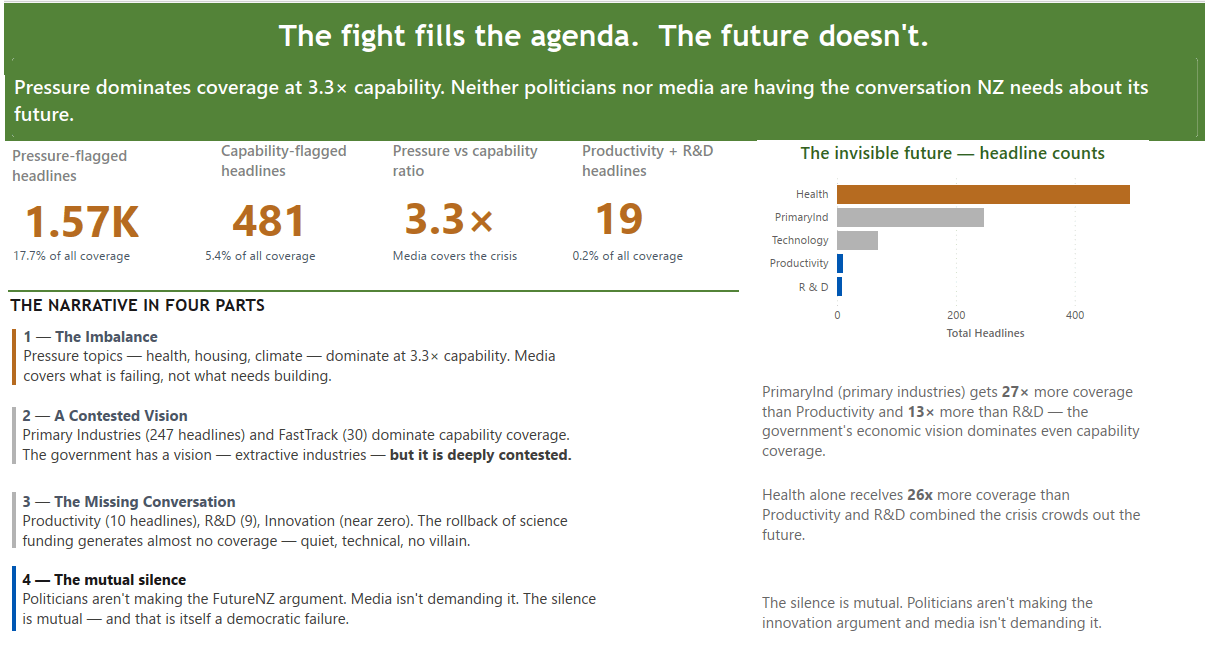
As it currently stands, our analysis of nearly nine thousand headlines since January shows a great ability to document today — its stuggles to engage with some of the important issues that will shape tomorrow. Here’s three of them:
- Productivity: 10 headlines
- R&D: 9 headlines
- Innovation: near zero and predominantly about the demise of Callaghan Innovation.
For comparison, health received 26 times more coverage than productivity and R&D combined.
The weight of now
One of the strands of our classification process is to mark headlines where an external force — a fuel crisis, a storm, a failing health system — is bearing down on is referenced – New Zealand these are Pressure flags . Capability flags mark headlines asking whether the people in charge can handle it.
Pressure dominated capability at 3.3 times the rate. Whilst this finding is not surprising.
Follow the link to the dynamic dataset https://socialherds.org/home/
~ ❦ ~
What is surprising is that the topics most connected to New Zealand’s long-term economic future barely register across five months of coverage, something structural is happening.
The future is being quietly crowded out by the present.
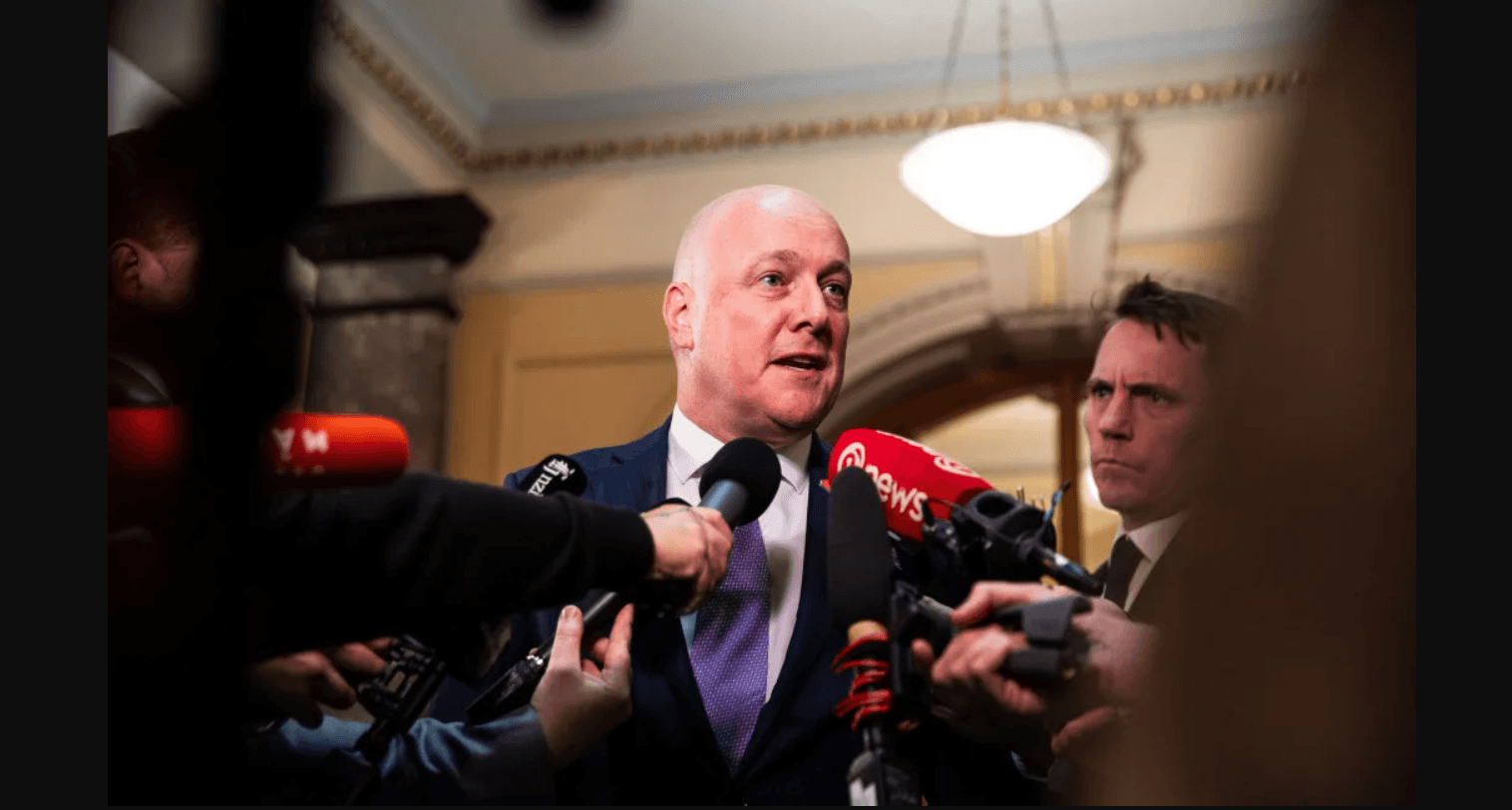
Crisis is news
~ ❦ ~
The Numbers NZ Doesn’t Talk About
This isn’t just a media observation – independent data says the same thing
New Zealand produces $46 per hour worked — well below the OECD average of $58, and nearly 40% behind the top half of developed economies. We work more hours per person than most OECD countries. We just get less out of them.
On R&D, the picture is just as sobering. New Zealand invests 1.5% of GDP in research and development — roughly half the OECD average of 2.7%, and a fraction of what small innovation-led economies like Denmark, Finland, and Sweden commit. The government’s own target of 2% was set over a decade ago. We still haven’t reached it.
The research quality is there — or was, when anyone was paying attention to it.
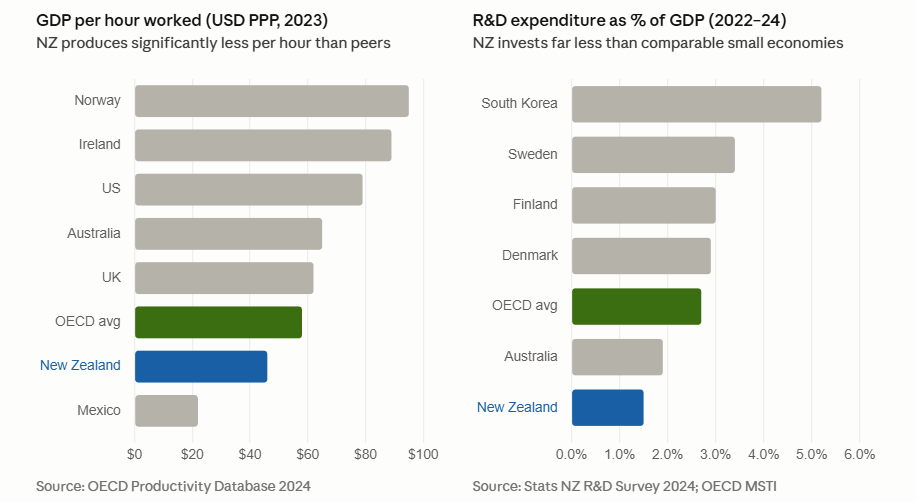
GDP per hour worked (chart on the left): 👉 https://www.oecd.org/en/data/indicators/gdp-per-hour-worked.html
R&D Expenditure as % of GDP — OECD MSTI (chart on the right): 👉 https://oe.cd/msti
For the Stats NZ R&D: 👉 https://www.stats.govt.nz (search “R&D survey 2024”)
The Great NZ Shrug
In 2020, MBIE briefed the incoming Minister of Research, Science and Innovation with a striking finding: 18% of New Zealand’s research publications ranked in the world’s top 10% most cited, outperforming the global average across almost every field. The briefing noted that despite lower investment than comparable countries, New Zealand’s research sector was unusually efficient — strong output per dollar.
By 2023, when MBIE briefed the new National-led government’s incoming Minister of Science, Innovation and Technology, that data was gone. The focus had shifted to structural challenges, funding constraints, and tech sector growth. The quality of what New Zealand produces intellectually — and what that says about our potential — didn’t make the cut.
It would be easy to blame journalists. But the data doesn’t support that alone.
Politicians aren’t making the argument either. The rollback of science funding — a significant policy shift with long-term consequences — generated almost no headlines. Why? It’s quiet, technical, and has no clear villain.
Media isn’t demanding the conversation about New Zealand’s future. Politicians aren’t initiating it. In that silence, coverage defaults to what it does best: documenting pressure, conflict, and crisis.
That’s not just a media failure or a political failure. It’s a democratic one.
Briefings reflect priorities.
If neither media nor politicians are consistently making the argument for New Zealand’s future — who will? And what does it cost us if nobody does?

~ ❦ ~
The price of silence
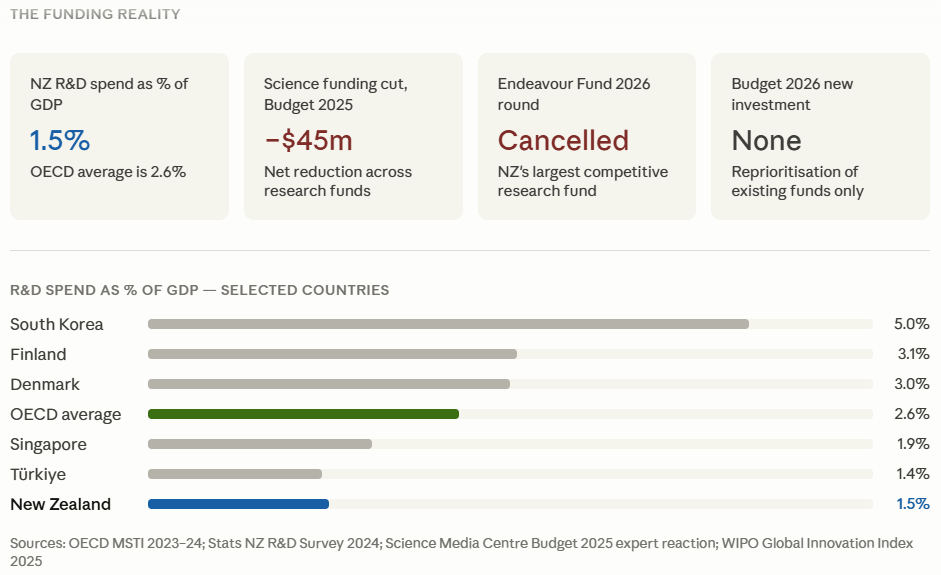
New Zealand spends 1.5% of GDP on research and development — just over half the OECD average of 2.6%, and roughly level with Türkiye.
The countries NZ politicians invoke when they talk about the future, that is the ones they wish to emulate — Denmark, Finland, Singapore — spend roughly double.
The Budget in 2025 cut science funding by $45 million. Budget 2026, handed down this week, added nothing new — only a reshuffling of existing funds. The Endeavour Fund, NZ’s largest source of competitive research grants, cancelled its entire 2026 funding round.
Public pressure follows media attention. Political prioritisation follows public pressure. When coverage consistently underweights productivity, R&D, and innovation — 19 headlines across four months — those topics struggle to gain traction regardless of their importance to New Zealand’s future.
The silence is mutual. Politicians aren’t making the case for investment. Media isn’t demanding it. And the funding data suggests the cost of that silence is already being paid.
We’ll be tracking this across the rest of 2026.