
Holding government to account
Journalists see holding government to account as central to their role — and since Budget 2026, that instinct has been on full display. Political scrutiny, Budget challenges and ministerial questioning have dominated the announcement and have continued to run in the weeks since.
In this blog we explore the challenges in measuring the size of the public sector, whether it is growing and how, and how the proposed government changes have been framed by different media groups.
Measuring the size of public sector
Accurately measuring the size of the public sector is more challenging than it may appear. There are two distinct definitions of “the public sector.” The core Public Service, which includes departments and ministries, employs approximately 63,700 full-time equivalents. In contrast, the broader public sector, which encompasses health, education, police, defense, and Crown entities, employs about 477,400 individuals. Much of the discussion shifts between these two definitions without clarification.
The Budget’s figure of 8,700 refers to the core Public Service and represents a forward target rather than the number of jobs already lost. The method you choose to measure the public sector significantly affects the results. Different metrics — total headcount, headcount relative to population, or headcount relative to the economy — each provide a different perspective. Additionally, making international comparisons can be quite complex. New Zealand’s broader public sector accounts for roughly 19.5% of total employment, which is close to the OECD average but significantly lower than that of the Nordic countries.
Is it growing?
Yes — on every defensible measure. The core Public Service grew from 47,252 FTEs in 2017 to a peak of 65,699 in late 2023: a 39% increase, three times the rate of population growth. The cuts since amount to around 4% from that peak, and the workforce began growing again in late 2025.
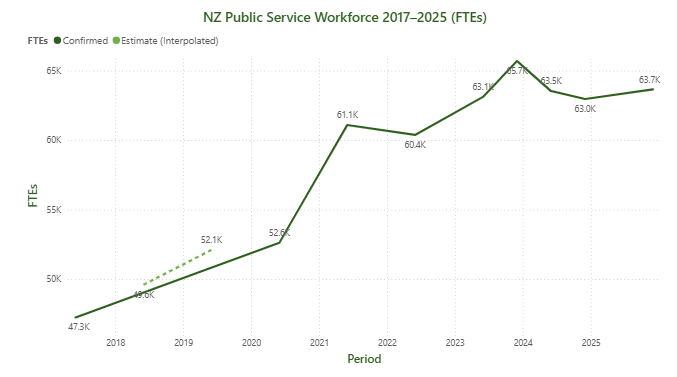

NZ Public Service Workforce 2017–2025 (FTEs).
The workforce grew 39% from 2017 to its late-2023 peak then fell 4% through 2024–25
However, the raw FTE counts, published by the Public Service Commission, don’t account for what else was growing: the population rose around 11% and the real economy around 17% over the same period. Adjusted for that growth, the expansion shrinks — but it does not disappear.
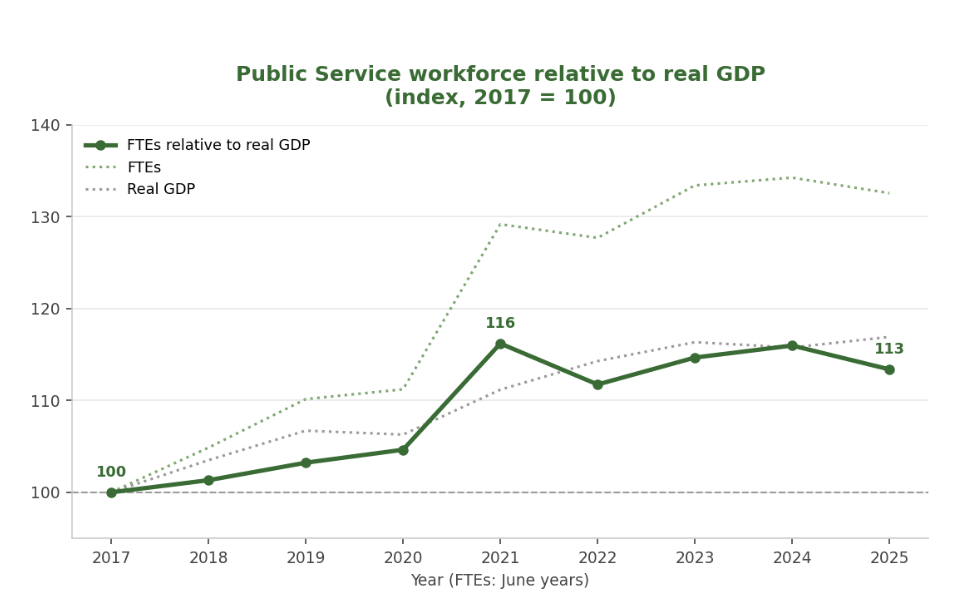
The graph above tracks the ratio of FTEs to real GDP, indexed so 2017 = 100. Each point on the green line answers the question: for every billion dollars of real output the economy produces, how many public servants are there, compared with 2017? Even after adjusting for economic growth, the workforce remains about 13% larger than in 2017.
Five ways the story was told
Beyond the day-to-day news from individual departments and organisations, journalists have framed the public-sector story in five distinct ways.
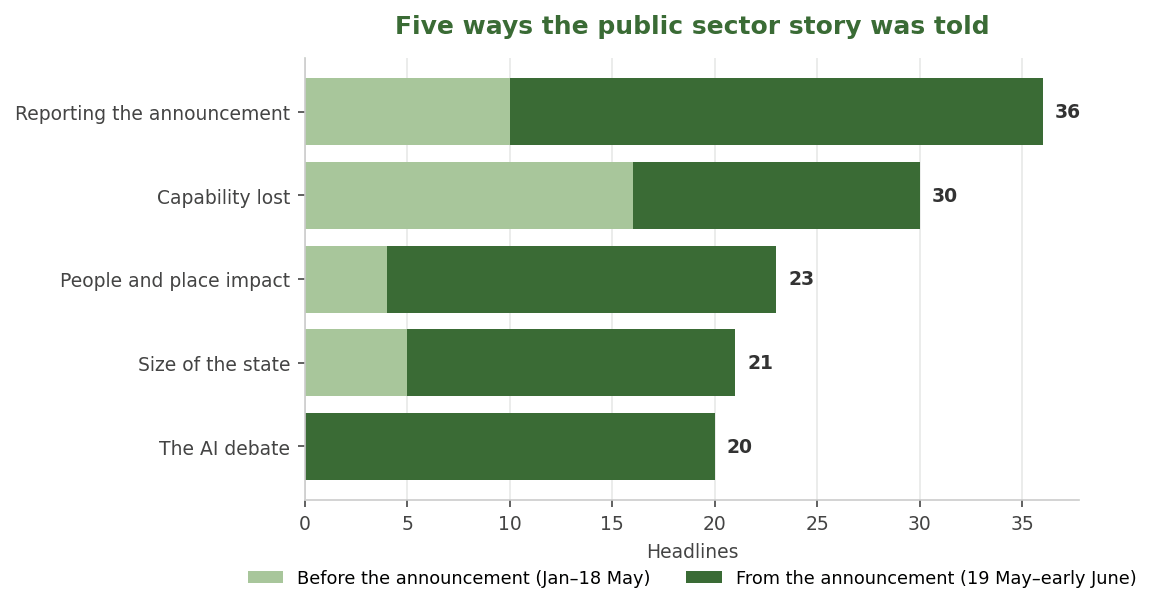
Capability was the only theme running strongly before the Budget. The AI debate did not exist until the announcement created it.
- Reporting the announcement was the biggest single block — jobs to go, departments on the chopping block, how the savings exercise will work. Visibility, not interpretation.
- Capability lost was the largest argued position — and the only theme already running strongly before the Budget. Through autumn, the stories were of erosion: science jobs cut, the census overhauled, agency systems failing. After the announcement, the question sharpened: can a public service be modernised after it has been hollowed out
- People and place: carried the emotional weight: Wellington as a ghost town, workers facing redundancy again, fears for Māori-focused agencies and provincial towns. These headlines ask who hurts, not whether the state is too big or losing capability.
- The size of the public sector was the smallest of the argued positions. Headlines making the case for a smaller, cheaper state — and they were the only ones that supplied the historical baseline. Among the argued positions, capability voices outnumbered smaller-state voices roughly three to one.
- The AI debate appeared from nowhere: not a single AI headline before 19 May, twenty after. It quickly became the proxy battleground for the capability argument — can technology replace 8,700 people, or is “cuts first, AI later” hollowing out the very capacity modernisation needs?
Capacity lost
Of the five, the capability theme deserves a closer look — because the strain was not confined to the public service itself. Capability questions ran right across the system in May and June: health above all, then the public sector, with education, defence, energy, media, local government and infrastructure all carrying the same concern. When the same question surfaces across so many domains at once, it stops looking like an agency problem and starts looking like a systems one. And it has not faded: the June bars cover only the first few days of the month.

Growth was never the story.
Whichever way the story was framed, one piece of context was almost absent: the growth charted above. Of more than 200 public-sector headlines in the dataset, fewer than 10 referenced workforce growth. Where that context appeared, it came from voices long associated with the case for a smaller state — the NZ Initiative’s Roger Partridge, broadcasters Heather du Plessis-Allan and Ryan Bridge, contributors to Kiwiblog and The Centrist — or from the minister defending the cuts, Paul Goldsmith. It never appeared as a baseline fact in a news headline. Headlines framed the story as 8,700 jobs going; almost none framed it as a 4% reduction following a 39% expansion. Nor was the coverage alarmist — only around one in ten headlines carried alarm framing. The gap was context. Readers were told what was being cut, but not what it was being cut from.
Fit for whose purpose?
One headline posed the real question: was this fat to trim, or muscle to cut?
Behind that question sit three competing definitions of purpose. A fiscal purpose: lower cost and a path back to surplus. An institutional purpose: a state capable of designing and delivering the test used by the OECD. And a community purpose: the people and places who carry the cost of change.
Each of the five framings spoke to one of these purposes — the size of the public sector, headlines for the fiscal case, the capability and AI headlines for the institutional one, the people-and-place headlines for the community that bears the cost.
But weighing those claims against each other required the one fact almost no headline carried: how much the workforce had grown in the first place.
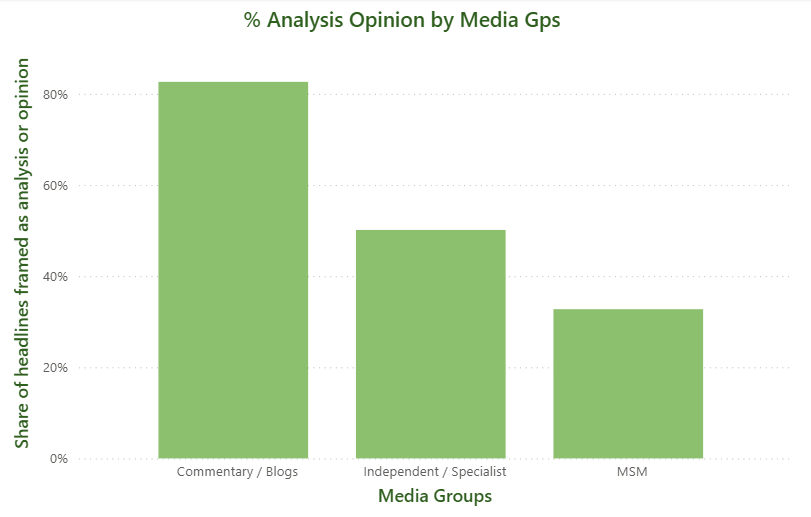
And the work was divided — mainstream outlets gave the story its reach, while independent and commentary sources supplied most of the interpretation.
Holding government to account is not only about asking whether promises were made. It is also about asking whether the country still has the capacity to keep them — and whose purpose the answer is meant to serve.