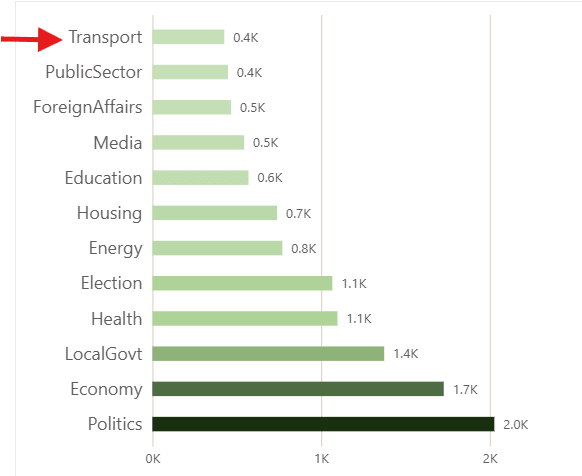
Transport ranks 12th among hundreds of topics in our three-year headline analysis, making it a prominent part of New Zealand’s media coverage. It also affects everyday journeys, freight movement and billions of dollars of public investment. The 2024–27 National Land Transport Programme forecasts $7 billion for state highway improvements and $4.6 billion for maintenance and operations across state highways and local roads.
While transport overlaps with infrastructure, our 2026 report examines 2,899 transport headlines and the distinct issues they reveal. It follows roads, rail, ferries, public transport and funding through a change of government and shifting priorities. Scrutiny often intensified after breakdowns, cancellations, rising costs and delays. Together, these stories raise a wider question: are spending decisions creating a reliable, connected transport network—and are we following delivery and performance long enough to know?
Transport is among New Zealand’s 12 most-covered topics
A central concern emerging from the analysis is the fragmented way New Zealand’s transport choices are debated and pursued: individual projects dominate, priorities change between governments, and the connections between decisions become harder to follow. New Zealand needs roads, rail, ferries and public transport that work together to move people and freight reliably, support growing communities and withstand disruption. Norway and the Baltic states offer examples of planning around those wider network needs. New Zealand has frameworks for doing this too; the challenge is ensuring they consistently guide investment and survive changes of government. New roads have added capacity, but premature pavement failures on relatively new highways show why opening an asset is only one measure of progress. The country also needs infrastructure that lasts, maintenance that protects it and lessons that prevent the same failures recurring.
Many projects, one network
Do the pieces work together?
Roads, rail, ferries and public transport are often discussed separately. The report asks how investment connects people, freight and regions across the whole network.
Cook Strait connections
Reliability reaches beyond the passenger journey
Ferry decisions affect freight, rail and port infrastructure. Comparing options requires looking at the complete system and its costs over the life of the assets.
Maintenance and durability
Repairing is not the same as preventing failure
Premature pavement failures raise questions about design, drainage, construction quality and accountability. How long should assets last—and who pays when they do not?
Cost versus outcome
What does transport spending achieve?
A price tag alone cannot tell us whether a project is worthwhile. Safety, access, resilience and alternatives need to remain visible as plans move towards delivery.
From announcement to delivery
For each commitment, ask: what will be delivered, where and by when? What is the full cost, what benefits are expected, and who is accountable if performance falls short?
2026 New Zealand Transport Report Summary — as told by the NZ media
Where does New Zealand need to make progress?
Our transport report identifies areas where decisions, delivery and accountability need to improve. The headline record does not establish every outcome, but it shows why these questions need answers.
Norway and the Baltic states offer examples of planning around what the whole transport network needs to achieve; New Zealand’s public debate more often centres on individual projects, making it harder to see how spending choices fit together to meet the country’s long-term needs.
Investment: explain priorities and trade-offs
New Zealand needs a clearer account of which transport problems should be addressed first, what different investments would achieve and what other work would wait. Major road commitments compete with maintenance, resilience and other transport needs for funding and construction capacity. Voters need to understand the choices behind the projects.
Ferries: secure a reliable Cook Strait connection
Progress means delivering a dependable passenger and freight connection, with suitable ferries, ports and rail capability. The replacement programme needs to demonstrate value over its lifetime, including cancellation costs, delay and disruption. This matters because ferry reliability affects businesses and the wider national network.
Maintenance: improve asset performance and prevent repeat failures
Progress means reducing renewal backlogs and ensuring roads and bridges perform for their expected lifespan. When relatively new infrastructure fails, investigations should establish the cause, responsibility and who pays—and show how lessons change subsequent projects. Repairing the damage is only part of preventing the next failure.
Climate: prepare for disruption and account for emissions
New Zealand needs clearer decisions about which vulnerable routes to strengthen, relocate or provide alternatives for, and how that work will be funded. Repeatedly restoring damaged connections can leave communities exposed to further disruption. Investment decisions also need to explain their effects on emissions: adapting to extreme weather and reducing emissions are separate responsibilities.
Housing and transport: coordinate delivery where growth is planned
Progress means providing transport capacity alongside new housing, with clear funding, responsibilities and timetables. Enabling homes without adequate connections can leave residents facing congestion, costly journeys or limited access to jobs and services.
Measure progress by what people can use.
The housing and transport stories share a question: do announcements become useful, lasting outcomes?
For transport, progress means safer and more reliable journeys, affordable access, infrastructure that lasts and connections that withstand disruption. Following those outcomes—and explaining what remains unfinished—helps voters distinguish progress from promises.
Transport case studies — what the report examines
Premature pavement failures
Ngāruawāhia, Cambridge and Transmission Gully illustrate the importance of design, drainage, materials, procurement and quality assurance. The report asks whether lessons from failures are retained and applied.
Aratere grounding
The grounding on 21 June 2024 raises questions about managing technical changes, ownership of safety risks and assurance across organisations.
Dome Valley
The report distinguishes investment in crash reduction from the separate question of maintaining access and resilience. A project can address one problem while leaving another unresolved.
These examples are used to examine decision-making and accountability; headline attention alone does not establish the quality of every project.
Political parties’ transport positions — as at 30 September 2026
This comparison covers the same six parties as our Housing page: National, Labour, Greens, ACT, New Zealand First and Opportunity. Sources include election proposals, standing policy and the governing parties’ delivery records; they are not equivalent types of commitment.
| Party | Main approach | Specific commitments | What remains unclear |
| National | Roads of National Significance and state-highway maintenance. | Its current infrastructure page describes the government’s delivery programme. Party source | Which roads will be funded and completed, by when, and with what whole-of-life benefits? |
| Labour | Lower public-transport fares through weekly caps. | From 1 July 2027: $20 weekly caps in Auckland, Wellington and Christchurch, and $10 elsewhere, with exclusions for some services. Party source | How will service frequency, capacity and coverage meet demand alongside lower fares? |
| Greens | Integrated public transport, rail, walking and cycling. | Standing policy supports staged moves towards fare-free urban public transport. Party source | What are the funded stages, regional priorities and delivery timetable? |
| ACT | Greater emphasis on project costs, maintenance and road-capacity planning. | Its September 2026 policy proposes publishing the lowest-cost safe option alongside preferred project options, protecting maintenance and using traffic thresholds to plan additional road capacity. Party source | How will safety, resilience, access and environmental effects be assessed alongside cost? |
| New Zealand First | Rail investment highlighted through the coalition government’s budget record. | Its Budget 2026 statement highlights $1.075 billion for KiwiRail. This is a budget record rather than a complete new election manifesto. Party source | What further rail, ferry and regional transport commitments will the party make, and how will performance be measured? |
| Opportunity | Fare-free public transport and long-term infrastructure planning. | Proposes permanent fare-free public transport, with greater emphasis on infrastructure maintenance, renewal and continuity. Public-transport policy · Infrastructure policy | How will operating costs, service expansion and the infrastructure programme be funded and delivered? |
| Te Pāti Māori | Transport affordability as part of reducing cost-of-living pressures on whānau. | Its current policy platform supports practical cost-of-living relief, including transport affordability. The policy summary does not specify fare levels, eligibility or a delivery timetable. Party source | What fare reductions and service improvements will be funded, who will qualify, and how will regional and rural communities benefit? |
Party positions can change. A policy announcement is not evidence that its proposed outcomes have been delivered.
Sources and updates after the report’s headline period
Report period: June 2023–3 August 2026. The report analyses media headlines, which indicate attention and framing. They do not represent a complete audit of articles or transport performance.
State-highway potholes: A government release dated 11 February 2026 reported 98% repaired within 24 hours of identification. This is a repair-response measure, not a measure of overall pavement condition or local-road performance. Read the government release.
Ferry programme: Ferry Holdings publishes statements of intent, performance expectations and infrastructure updates. Its releases include an updated 2025–2029 Statement of Intent published on 16 September 2026, after the report’s headline cutoff. Read Ferry Holdings updates.
Political-party sources: The dated comparison above links to each party’s own published material. Delivery questions are Social Herds’ questions for evaluating those commitments.
Related analysis
New Zealand has many transport plans and many transport projects. Do they collectively create the network the country says it needs—and are we following the story for long enough to know?