

Promises are easy. Delivery is harder.
What one week of headlines revealed about government capacity—and whether today’s promises can survive long enough to deliver.
Between 12 and 20 July 2026, SocialHerds recorded 643 New Zealand political and public-policy headlines.
The largest single topic category was Election, with 80 headlines. Paul Henry’s involvement with ACT, the positioning of New Zealand First and the early manoeuvring of National, Labour, ACT and TOP gave parts of the week the unmistakable feel of election positioning beginning to take shape.
But the more substantial story sat beneath the election coverage.
Promises were already a recurring feature of political coverage in 2026, including commitments on infrastructure, maternal mental healthcare, public transport, affordability, farming costs and payment surcharges.
Across health, infrastructure, transport, housing, energy, climate, the environment, local government, justice and the public sector, the same underlying question kept resurfacing: does New Zealand have the financial, physical and institutional capacity to deliver what its politicians promise and its population needs?
Roads had been promised but could not all be funded. Regional airports and air routes were under pressure. Questions continued over Cook Strait ferry planning. Hospitals faced emergency-department congestion, workforce shortages, service closures and demands for accountability. Electricity-sector warnings became more urgent. Councils confronted amalgamation costs, water infrastructure and governance problems. Climate and fast-track processes were delayed or disputed.
These were separate stories, reported by different journalists and media organisations. Taken together, however, they formed a recognisable pattern: political ambition was repeatedly colliding with the practical limits of delivery.
Political coverage was calmer than delivery coverage
Whilst political coverage included criticism, conflict and strategic positioning, it was predominantly neutral in direction. Coverage of the practical business of governing was much more negative.
That does not automatically mean the Government was performing poorly. A headline classification cannot make that judgement.
It does show that the anxiety in the week’s political news was attached less to election positioning itself than to questions about whether public systems, projects and services were working.
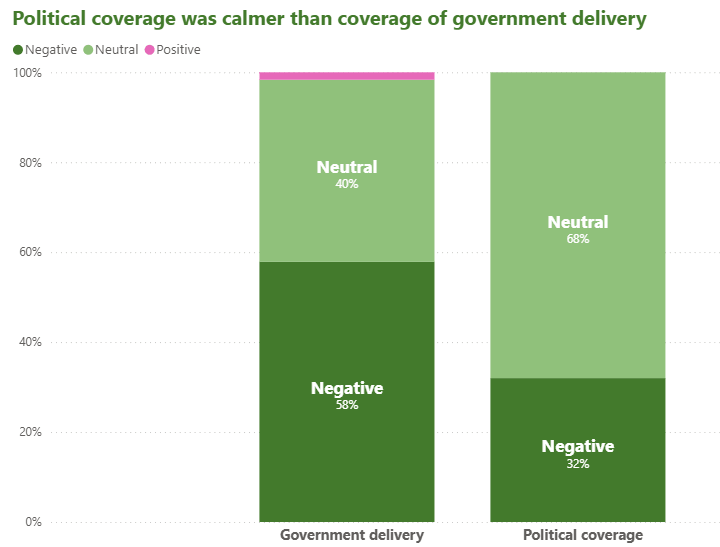
Political coverage was calmer than coverage of government delivery. Source: SocialHerds analysis of headlines published from 12–20 July 2026.
Was this simply the media being negative?
A government could reasonably respond that these figures reveal as much about news values as they do about government performance.
Problems, delays and conflict are more likely to become headlines than hospitals operating normally, roads remaining open or electricity arriving when someone turns on a switch. Much of government is routine, and routine success is rarely news.
That caution matters. A negative headline is not, by itself, evidence of government failure. Nor do headline counts measure public opinion, readership or the quality and balance of the full article.
The negative delivery coverage was not confined to one journalist, one media organisation or one part of government. It appeared across health, local government, transport, infrastructure, housing, energy, climate and the environment.
But the week’s pattern cannot be dismissed simply as a preference for bad news.
Negative delivery coverage appeared across major media groups
The pattern appeared across public, commercial, national, regional and independently published media. The groups shown each published at least ten government-delivery headlines during the period.
The media did not all tell exactly the same story, and the number of headlines differed between ownership groups. But concerns about delivery were sufficiently widespread that they cannot easily be attributed to one publication or editorial position.
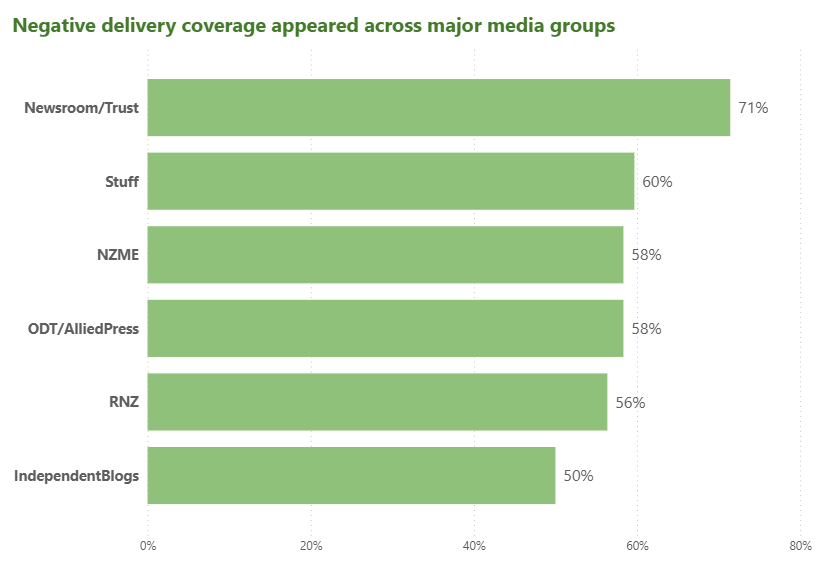
Negative delivery coverage appeared across major media groups. Ownership groups shown had at least ten government-delivery headlines.
Delivery Issues in Transport and Infrastructure
The week included headlines such as:
• The $56 billion broken promise
• National took a credibility hit on roads
• Why New Zealand keeps promising roads it cannot build
• Where are my new roads, man?
• Trucking industry disappointed two Auckland roading projects put in the slow lane
Other reports referred to Treasury risk assessments, rising costs, rejected projects and uncertainty around the timing or affordability of major works.
Some of this coverage was openly opinionated. But the underlying issue was more than political criticism. It concerned the relationship between announced projects, available money, construction costs, planning systems and the state’s ability to complete what had been promised.
Roads became a credibility story.
The question was no longer only whether a new road would be desirable. It was whether political commitments had been made before the necessary funding, sequencing and delivery capacity had been secured.
A promise can be popular and still be impractical. A project can be necessary and still be unaffordable within the proposed timetable. A policy announcement can signal political intent without demonstrating that the institutions responsible for delivering it are ready.
Health carried the heaviest negative weight
Health produced 38 headlines during the period. Thirty-one were classified as negative. The headlines included pressure in emergency departments, mental-health service closures, unmet maternal mental-health needs, workforce problems, patient deaths and demands for accountability. Examples included:
• How my mother’s terminal diagnosis gave me insight into the ED crisis
• Patients face being sedated, flown north as Dunedin mental health ward closes
• Maternal mental healthcare: A third of mothers who need support are going without it
• Health NZ faulted over Gisborne Hospital patient’s post-surgery death
• Family demands accountability after Palmerston North Hospital tragedy
Health is particularly susceptible to negative coverage because the consequences of failure are personal, immediate and sometimes devastating. It would therefore be misleading to compare the sector directly with election coverage and conclude that the difference is solely a measure of political competence.
However, the headlines also pointed to issues extending beyond isolated incidents: workforce capacity, access to services, system coordination and the ability to maintain services outside the main centres.
The recurring question was not simply whether one minister had made a mistake. It was whether the health system had enough people, facilities and organisational capacity to meet demand.
Health carried the greatest number of negative delivery headlines, but it did not produce the pattern by itself.
These figures should not be treated as a league table of government performance. They show where delivery concerns appeared in the news, not which part of government performed worst.
In energy, headlines warned about electricity-sector adaptation, workforce shortages and the uncertain economics behind promised solutions.
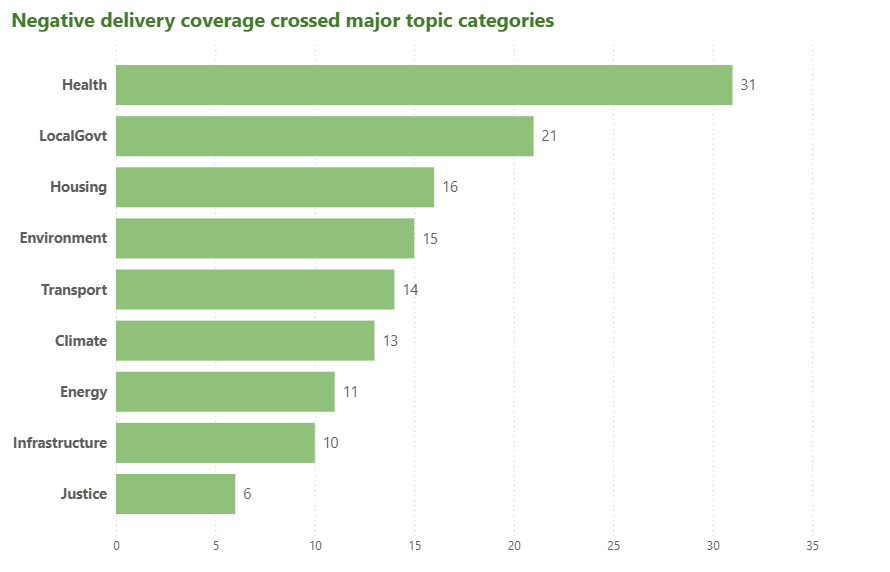
Negative delivery coverage crossed major topic categories. Source: SocialHerds, 12–20 July 2026.
(Counts are used rather than percentages so that small categories do not appear disproportionately important.)
Negative delivery was present in other major topic categories
In housing, stories covered homelessness, emergency-housing restrictions, construction costs and the effects of short-term accommodation. In local government, there were questions about amalgamation costs, infrastructure responsibilities, council conduct and the relationship between local and central government.
Climate and environmental coverage included delayed adaptation decisions, a failed taxpayer-supported satellite mission, disputed briefing processes, water-quality concerns, biodiversity risks and arguments over mining and bottom trawling.
Each story had its own causes. But they shared recurring constraints:
• insufficient or uncertain funding;
• shortages of skilled workers;
• ageing or inadequate infrastructure;
• delays in planning and decision-making;
• unclear responsibility between institutions; and
• difficulty turning policy announcements into implementation.
This is why the broader story matters. Readers were not merely encountering a collection of unrelated bad-news events. They were repeatedly encountering different versions of the same national problem.
A better future for New Zealand’s was present, but sporadic
Important future-facing coverage addressed artificial intelligence, data centres, digital sovereignty, electricity storage, grid capacity, regional aviation, climate adaptation, biodiversity, infrastructure, housing and New Zealand’s persistently low productivity.
Two notable contributions stepped back and connected them.
In the introduction to the Helen Clark Foundation’s forthcoming book Facing Up to Our Future: Challenges and Choices for New Zealand, editor Emeritus Professor Peter Davis argued that New Zealand has repeatedly failed to act on long-signalled problems.
Drawing partly on the work of University of Canterbury academics Sonia Mazey and Jeremy Richardson, Davis described a policy system that is often short-term, reactive and lacking continuity.
The article connected water infrastructure, climate adaptation, fisheries management and the future costs of health and superannuation. Although these issues are normally reported separately, he placed them within one larger failure of “intergenerational foresight”: recognised problems are deferred because difficult action carries immediate political costs, while much of the eventual burden falls on future generations.
In an article for The Conversation, Professor Jonathan Boston of Te Herenga Waka —Victoria University of Wellington addressed concerns regarding the upcoming election. He noted that while parties were proposing long-term policies on retirement saving, taxation, and climate change, sustaining these policies is more challenging than merely announcing them. Durable progress requires cross-party agreements and political incentives that encourage persistence.
Boston highlighted the need to connect various issues—like unaffordable roads, aging infrastructure, and climate adaptation—into a cohesive national challenge. He and Davis argued that the crucial issue is not just initiating policies but ensuring that New Zealand’s political system can sustain them effectively.
Were delivery failures explained?
A reader could learn that a road had been delayed, an ambulance had waited outside an emergency department, a regional airport was struggling, an electricity-sector watchdog had issued a warning and a climate process had fallen behind schedule. But the harder story – and perhaps the most important one: does New Zealand have the capacity and the political persistence to deliver.
These questions are less dramatic than political conflict, but they are essential to informed political choice.
- Does the necessary workforce exist?
- Has continuing funding been identified beyond the initial announcement?
- Are the responsible agencies capable of implementation?
- Does the policy depend on legislation, consenting, local government or infrastructure that is not yet in place?
- What other commitments would have to be delayed or abandoned?
- Would another change of government undo it?
- How long would meaningful delivery actually take?
Election coverage may supply the personalities. The promises may supply the headlines.
The election questions should be: can it be delivered, and will it last?
But was the common problem made clear? Was the public helped to understand whether these were temporary difficulties, the result of particular political choices, or signs of deeper limitations in New Zealand’s capacity to plan, fund and deliver?
Within government-delivery coverage, 23 headlines were flagged for Capability—whether institutions had the workforce, funding, infrastructure or organisation needed to deliver. Nineteen were negative, three were neutral and only one was positive. Six further headlines were flagged as Pressure: five negative and one neutral.
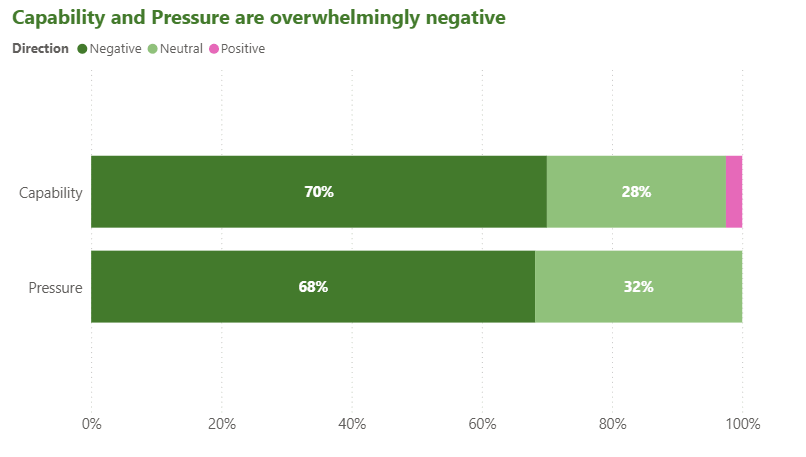
Capability and Pressure headlines were overwhelmingly negative. Of 23 Capability headlines, 19 were negative; five of the six Pressure headlines were also negative.
What was less clear was the underlying causes of of NZ limited capability to deliver.
The media was more likely to encounter questions of government capacity through breakdown, shortage or failure than through evidence that systems were improving or succeeding. There were 38 Analysis headlines, but analysis is not necessarily the same as identifying a remedy: it may explain why a problem exists without showing what institutional or political changes would allow it to be fixed.
Reporting each failure separately can create a powerful sense that nothing works. It does not necessarily explain why things are not working, what would have to change, or how progress could be sustained. Voters need to know not only what must be true for a promise to be delivered, but whether it is supported by long-term planning, institutional continuity and, where necessary, cross-party agreement strong enough to survive changes of government.
That is the difference between reporting pressure and explaining capability.
This analysis covers 643 political and public-policy headlines collected by SocialHerds between 12 and 20 July 2026. The political comparison includes the Election, Politics and Polls topic categories. The government-delivery comparison includes Health, Infrastructure, Transport, Housing, Energy, Climate, Environment, Local Government, Justice, Government Performance and the Public Sector. Headlines were classified by topic, framing, direction, media organisation, ownership and other features. A headline can show what was made visible in the news, but it cannot establish whether the full article was fair, whether audiences read or believed it, or whether a government or institution was ultimately responsible. The analysis therefore treats negative coverage as a feature of the media conversation, not as direct proof of government failure.